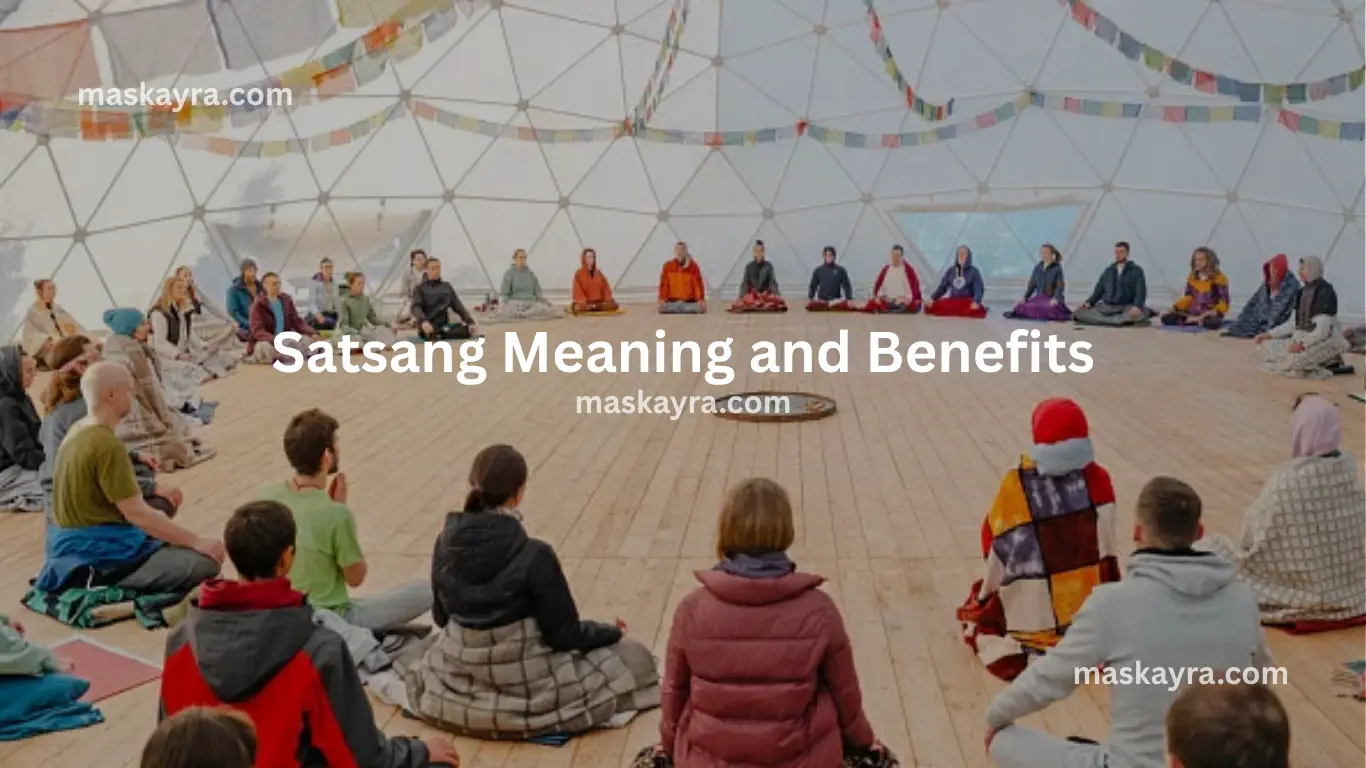
The term Satsang originates from the ancient Sanskrit language, where “Sat” means truth or the highest truth, and “Sang” means association or gathering. When combined, Satsang meaning becomes “being in the company of truth” or “association with like-minded uplifting people who seek truth.” In modern understanding, what is satsang can be described as a spiritual gathering where individuals come together to explore deeper aspects of life, the mind, and the true self.
In the context of the yogic path and spiritual teachings, satsang is not just a physical gathering. It represents a shift in awareness—from material attachments toward inner clarity. Whether it happens in a satsang ashram, during online satsangs, or even through reading sacred texts like the Bhagavad Gita, the essence remains the same: aligning yourself with truth and presence.
Many spiritual masters, including Gurudev Sri Sri Ravi Shankar, emphasize that satsang is about reconnecting with your natural state of peace and joy. It helps spiritual seekers move beyond the noise of daily life and connect with their heart and mind in a deeper way. For those asking what is satsang in Hinduism, it is considered a powerful practice that accelerates spiritual growth and supports the spiritual journey.
Even today, global communities like Radha Soami Satsang Beas or satsang gatherings organized worldwide continue to keep this ancient tradition alive. Whether you attend a satsang near me search result or join a satsang tour, the purpose is always to experience truth, presence, and the transformative power of shared consciousness.
Table of Contents
The Essence of Satsang: Translation and Philosophical Satsang Meaning
Before we delve into how satsang works in practice, it’s important to understand the Satsang meaning behind the word itself. In Sanskrit, each root carries a precise semantic charge, and satsang is no exception. At its core lies a method of directly exploring the nature of human consciousness.
Origin of the term in Sanskrit
The word satsaṅga is composed of two roots: Sat (sat) and Sanga (saṅga)
Sat (sat) is not just “truth” in the ordinary sense. According to Iyengar’s glossary for Pranayama, sat means “Being, reality, truth, Brahman, or the Supreme Spirit.” It is the absolute, eternal, and unchanging existence that existed before the emergence of names and forms. In the non-dual (Advaita) paradigm, sat represents the fundamental nature of reality, free from the distortions of the ego, concepts, and mental constructs.
Sanga (saṅga) is a gathering, being in the company of others, or contact. The root does not simply refer to physical presence, but to a qualitative connection that transforms the participant. Historically, it referred to being in the presence of someone who had already attained absolute truth (an enlightened master or guru), or a gathering of like-minded individuals united by a common goal of self-discovery.
Satsang is not a lecture, a seminar, or a religious service. It is a qualitative way of being: being close to someone who is rooted in the Truth, with the expectation that this state will be transmitted and transform the participants. The classical texts of the Upanishads explicitly state that intellectual study of the Vedas does not lead to liberation; knowledge must be transmitted in the presence of a realized teacher to a disciple.
Historical background: The classical texts of the Upanishads (such as the Mundaka Upanishad) and the works of the philosopher Shankara (8th century) explicitly state that intellectual study of the Vedas does not lead to liberation. Shruti (heard knowledge) must be transmitted in the presence of a realized teacher to a disciple. This heart-to-heart transmission format has become the foundation of what is now known as satsang worldwide.
The main goal of practice is to transmit a state, not information.
This is the fundamental difference between satsang and any other educational format. The Hatha Yoga Pradipika (translated by Saraswati Swami) explicitly states that the tradition of satsang is for people to gather around a person with spiritual knowledge and discuss matters related to the soul. It emphasizes that it is not necessary to discuss only siddhanta (systematic teachings) but that one can listen to conversations on various spiritual topics.
Contrary to stereotypes, satsang does not work with the accumulation of information, but with its cutting off. The main task of the master in such a meeting is to help the seeker stop the endless internal dialogue, redirect attention from the plane of reflection to the plane of pure presence, and deconstruct false beliefs.
The point is not the content of the words, but the field that the presence of a realized person creates. In The Tree of Yoga, Iyengar describes meditation as a state in which “continuous awareness of the unity of body, mind, and soul” becomes self-sustaining. When a person in this state is present in the same space as a group of seekers, their minds receive a living guide. This is why classical texts emphasize that a guru dispels the darkness of ignorance with the light of consciousness, rather than a set of rules.
The central mechanism of satsang is the phenomenon of state transmission. In neurobiology and the psychology of group dynamics, there is a concept of “limbic resonance,” which refers to the ability of people’s nervous systems to synchronize with each other. When an individual with a completely relaxed nervous system is present, the audience can easily adopt this state without any additional effort to concentrate.
To simplify this abstract idea, we can use the analogy of a cinema, which is popular in the philosophy of non-duality (Advaita). The human mind is like a screen on which a drama is being broadcast—our daily lives. In a satsang, the master helps the viewer to take their eyes off the exciting plot of the movie and notice the projector light and the blank screen, acting as a detached witness.
Many people come to the first satsang with the mindset of “coming out with answers to life’s questions.” The rational part of the mind will analyze every word. This is normal. However, experience shows that the most significant shifts occur not during intellectual effort, but in the pauses, in the shared silence after the teacher’s speech. Allow yourself to simply be, without trying to “take” anything.
This principle is deeply rooted in the Vedantic tradition. Adi Shankara’s “Vivekachudamani,” a fundamental text of Advaita Vedanta from the 8th and 9th centuries, is structured entirely as a dialogue between a Guru and a Disciple, where key insights are achieved not through rote memorization but through direct contact between their minds. Satsang replicates this format, where it is not a monologue or a lecture, but a lively dialogue between someone who already sees and someone who is searching.
Dress Code for Satsang: What to Wear and Why It Matters
One of the practical questions people often ask is about the dress code for satsang. While there is no universal rule, the general expectation is modest, comfortable, and respectful attire. Since satsang often takes place in a calm and quiet area, clothing should support relaxation and focus rather than distraction. For those wondering what is the dress code for satsang, simple clothing like loose-fitting pants, traditional wear, or comfortable yoga attire is usually appropriate. In a satsang ashram setting, white or light-colored clothing is often preferred as it symbolizes purity and simplicity.
Questions like what are the four dress codes or what are the five dress codes usually arise in structured communities or organizations. These may include guidelines such as modesty, cleanliness, simplicity, cultural appropriateness, and comfort. However, these are not strict universal rules but rather suggestions to maintain a peaceful environment. If you’re attending a satsang tour or visiting an ashram for the first time, it’s always a good idea to dress conservatively. Avoid flashy or overly casual clothing, and choose something that allows you to sit comfortably during meditation.
Ultimately, the purpose of any dress code is not to enforce rules but to create an atmosphere of respect and mindfulness.
How Satsang is Conducted: Stages and Formats of Meetings
Having dealt with the philosophical foundation, let’s move on to the practical side: what exactly happens in the space that is called satsang. Formats can vary from ashrams in India to lofts in Europe, but the basic structure is governed by the logic of working with human attention.
Classic meeting scenario
A typical offline satsang, lasting about two hours, unfolds in several consecutive phases.
Setting up and opening (15-30 minutes). Singing mantras or sitting quietly. The group transitions from the “busyness of the day” mode to a state of presence. The mantra acts as an acoustic anchor, as the repetitive sound pattern calms the chitta-vritti (mind fluctuations) and the nervous system.
Group meditation (20-30 minutes). Controlled or silent sitting. This is the central moment: the group creates a shared field of silence. Individual disturbances are reduced because collective resilience supports those whose minds are troubled today.
Speech and direct transmission (30-40 minutes). The teacher takes the floor and speaks about the nature of the mind, self-knowledge, often commenting on fragments of ancient texts or using metaphors from everyday life. The speech is not pre-prepared; it organically flows from the mood of the audience and may change direction. The topic often focuses on the mechanisms of suffering and the illusory nature of the ego.
Research and question block (30-40 minutes). Vichara (self-exploration) practice. Participants ask questions. This is the most lively part, the so-called vichara practice: the answer given to a specific person’s pain often resolves the unspoken question of several attendees. The master often uses the technique of self-exploration (atma-vichara), returning the question to the author to help them see the root of their illusion. The meeting concludes with a traditional silence to assimilate the acquired state and a slight bow (namaste).
The space is organized simply: people sit on the floor on cushions or on chairs in a semicircle facing the teacher. There is no stage, no pulpit in the religious sense — there is a difference in levels of experience, not power.
Is Satsang a Religious Practice? Understanding Its Universal Nature
A common question is whether satsang is tied to a specific religion. While satsang has roots in Hinduism and is deeply connected to Indian spiritual traditions, it is not limited to any one belief system. Instead, it is a universal practice focused on truth, awareness, and self-realization.
When people ask what religions practice satsang, the answer is broader than expected. Variations of satsang exist in many traditions, including Buddhist gatherings, Christian fellowship groups, and even modern mindfulness communities. The core idea—coming together to explore truth and grow spiritually—is universal. Organizations like Radha Soami Satsang Beas or structured systems like satsang exam programs (including satsang exam login platforms) provide organized approaches to learning. However, satsang itself does not require membership. Anyone can attend a satsang near me or join online satsangs without prior experience.
This openness is what makes satsang so powerful. It removes barriers and invites everyone—regardless of background—to explore their true nature. Whether you’re following the yogic path, studying the Bhagavad Gita, or simply seeking peace in daily life, satsang offers a welcoming space.
Types of formats
The modern practice of satsanga exists in several forms, each of which preserves the core under different external conditions.
Traditional (ashramic) satsang: involves a certain discipline, reverence for the line of knowledge, and adherence to traditional Indian rituals. It is practiced in classical ashrams.
Neo-Advaita (Western format): characterized by its democratic nature, lack of strict rituals, and participants’ casual attire. The focus is on immediate awareness of the “here and now,” rather than a long journey of purification.
Online satsangs: have become widespread since 2020. The quality of state transmission through a screen is a subject of debate: many people note that a live presence creates a different type of resonance (the effect of limbic resonance may be weaker through a screen). For integrating practice into everyday life, the online format through Zoom or YouTube works well.
Multi-day retreats: the most intense form. Immersing oneself for three to ten days (or up to 21 days) outside of one’s usual environment significantly deepens the changes, as the mind is isolated from society and receives fewer familiar stimuli. It is often combined with hatha yoga.
Silent Satsang (Mauna): the most demanding and authentic format, which completely eliminates verbal communication. The teacher and students sit in silence. This format is based on the practice of Sri Ramana Maharshi. The mechanics of the process are similar to a tuning fork, which vibrates an adjacent string when it is tuned to a specific frequency. Similarly, the deeply focused state of the teacher “synchronizes” the students without any spoken words. This format requires a certain level of preparation from the participants.
Benefits of Satsang: Why It’s Essential for Spiritual Growth and Daily Life
The benefits of satsang go far beyond temporary peace. Regular participation in satsang gatherings can bring lasting transformation in both spiritual and practical aspects of life. One of the most significant benefits is clarity of mind. In today’s fast-paced world, the mind is constantly overwhelmed with information, distractions, and stress. Satsang provides a space to slow down and reconnect with the present moment.
Another major benefit of satsang is emotional healing. Being in the company of good people and spiritual seekers creates a supportive environment where individuals feel understood and accepted. This reduces feelings of isolation and helps in building a stronger connection with the heart.
From a spiritual perspective, satsang accelerates spiritual growth by exposing individuals to higher wisdom and spiritual teachings. Whether through listening to spiritual masters, engaging in guided meditation, or reflecting on the highest truth, participants begin to move closer to their true self. Over time, this reduces attachment to material attachments and fosters a sense of inner freedom.
Interestingly, the benefits of satsang also extend into daily life. Improved focus, better decision-making, and a calmer response to challenges are commonly reported by regular attendees. Even short participation in online satsangs can positively impact mental well-being.
For those on a spiritual journey, satsang acts as a compass. It keeps you aligned with your purpose and reminds you of what truly matters. This is why traditions across cultures emphasize the importance of staying in the company of truth.
What are the benefits of satsang meditation for modern people?
A person who is far from both religion and a specific tradition has the right to ask a direct question: why do I need this? The answer lies in both psychological and existential planes.
Psychological unloading: stopping the internal monologue
One of the most exhausting aspects of living in an information-overloaded world is the constant internal dialogue. In his book “The Yoga Tree,” Iyengar describes this phenomenon accurately: “There is a constant and habitual mental chatter that needs to be reduced to zero.” Satsang provides one of the most conducive environments for this, as the structure of the meeting naturally shifts attention from internal dialogue to presence.
In neuroscience, there is a concept of the Default Mode Network (DMN). This network is overactive when we are immersed in rumination, which involves rehashing past grievances and worrying about future scenarios. Satsang deactivates the DMN, allowing the nervous system to rest deeply.
The practice of pranayama (described in “The Path to the Secrets of Pranayama”) explains a similar mechanism through the neutralization of verbal inner monologue: when the “mechanism of internal verbalism is turned off,” the mind becomes clear and capable of observation. Satsang works in a similar way, but through a social field: the silence of a group is more powerful than the efforts of a single practitioner.
What Happens at a Satsang? A Deep Dive into the Experience
If you’ve ever wondered what happens at a satsang, the experience can be surprisingly simple yet deeply profound. A typical satsang gathering may include guided meditation, chanting, spiritual teachings, and open discussions led by spiritual masters or experienced practitioners. Unlike a formal religious ceremony, satsang focuses more on inner experience than rituals.
During a satsang, participants often sit in a quiet area, creating a peaceful environment that allows the mind to settle. This stillness helps individuals become aware of the present moment, which is a central theme in most spiritual teachings. The presence of like-minded uplifting people amplifies this effect, creating a shared energy that many describe as calming and transformative.
In many satsang yoga traditions, music also plays a key role. Devotional songs or a satsang band may perform, helping attendees connect emotionally and spiritually. This musical aspect often opens the heart, making it easier to release stress, anxiety, and mental clutter.
For beginners exploring what is a satsang, it’s important to know that there’s no rigid structure. Some gatherings may include discussions of texts like the Bhagavad Gita, while others focus purely on meditation and silence. In some communities, satsang diksha (initiation) may be offered, and resources like satsang diksha pdf or satsang exam materials (such as satsang exam BAPS or BAPS satsang exam papers with solutions PDF) are available for deeper study.
Ultimately, what happens at satsang is a gradual shift. The mind becomes quieter, the heart opens, and individuals begin to experience their true nature beyond thoughts and emotions.
Satsang and Psychotherapy: What’s the Difference?
Satsang does not replace classical psychotherapy. Psychotherapy works with the personality — restores its structure, helps to adapt in society, works out childhood traumas and builds personal boundaries. Satsang acts on an existential level, offering to disidentify with the very concept of “I” (ego).
In modern psychology, there is a term “spiritual bypassing” — a situation where unresolved psychological problems are masked by high spiritual concepts like”my personality does not exist, so there is no problem.” An honest approach requires sobriety: Satsang will not solve financial difficulties or clinical depression, but it will give you the utmost clarity of mind to act in these situations without inner anguish.
| Comparison parameter | Satsang (Advaita/non-duality) | Psychotherapy (CPT/psychoanalysis) | Classical meditation (vipassana) |
| Main object | The Illusion of the Self (Ego) | Personality structure and behavior patterns | Attention, nervous system reactions |
| Role of the moderator | Catalyst, mirror, pointer | Specialist, analyst, doctor | Instructor, method guide |
| End goal | Disidentification with the mind, awareness | Healthy, socially adapted personality | Stopping internal dialogue, reducing stress |
| Attitude to the problem | Research who exactly is experiencing the problem | The problem needs to be recognized, worked on, and integrated | The problem needs to be observed without reactivity |
The Power of Group Dynamics
When several people turn their attention inward at the same time, what can be described as a collective field emerges. A person who comes with an anxious mind receives support from the environment, and they do not need to confront their own fluctuations alone. The Hatha Yoga Pradipika explicitly states that “satsang preserves mental and emotional energies and keeps a person’s consciousness in the realm of spiritual vibrations.”
The psychology of group dynamics explains this by the effect of synergy and the formation of a safe space. The mechanism of social proof and mirror neurons works: the psyche reads the markers of relaxation from those around, allowing the protective mechanisms to loosen their grip.
From the perspective of habit psychology, one of the main reasons for the failure of meditation practice is the lack of social support. Regular group meetings create an anchor: the brain automatically associates a specific environment with a state of peace. This is why it is easier to enter meditation at a satsang than at home.
The group field acts as an amplifier. Switching to the alpha brain rhythm on satsang takes minutes, forming a stable neural connection “stopping thoughts = safety = resource”.
Change of focus: Mirror effect
One of the most valuable features of the “questions and answers” format is that someone else’s question often turns out to be your own. As one person describes their own impasse, such as anxiety or burnout, others experience an internal “this is me.” The teacher’s response, tailored to the individual, provides an opportunity to view their situation from a new perspective, one that is more detached. The teacher acts as a mirror, reflecting not the content of your life drama but your true nature, free from it. This shift away from an egocentric perspective (“my problem”) has a profound therapeutic effect.
Rules of Conduct: How to Prepare for Your First Meeting
Most of the ethical norms of satsang are not imposed from above — they logically follow from the very essence of the practice. Preparation does not require physical training or studying complex texts, the main thing is the sincerity of the intention. Compliance with basic etiquette is a sign of respect for the process and the space.
Appearance and basic etiquette. Clothing should be comfortable, allowing you to sit upright for two hours. Covering your shoulders and knees in traditional spaces is a sign of respect for the format. Turn off your smartphone before entering: an active phone disrupts the collective silence (make sure to turn off all sound and vibration alerts). Being on time is important: being late disrupts the entire room, as slamming doors break the delicate silence of the initial setup.
Inner attitude. Iyengar wrote that a student should have a “sincere aspiration and a spirit of humility.” Leave behind the expectation of a miracle or mystical experience—come with the concept of a “beginner’s mind.” There is no need to agree with everything you hear. It is more useful to come with an open question than with a preconceived opinion. Be prepared for the mind to generate boredom or skepticism—this is a natural part of the process.
How to ask a question to a master. A master works not so much with the content of the question, but with the state from which it is asked. The most valuable questions are born from real vulnerability. “I understand the theory, but I lose my awareness in stress — what should I do?” or “Who is the ‘I’ who is experiencing this pain right now?” are excellent questions for self-exploration. On the other hand, “Prove that your philosophy is correct” is an attempt at an intellectual duel that will create tension in the room. Satsang is not a philosophical debate, but a targeted effort to remove ego illusions.
How to distinguish true satsang from a destructive cult
This question is one of the most logical. Most modern satsangs are eco-friendly spaces, but the market of spiritual practices is not free from manipulation. A genuine satsang destroys any belief systems, including blind faith in the teacher himself. A true master never binds an apprentice to himself.
The Red Flags of a False Guru
The Hatha Yoga Pradipika describes a qualified guru: he is pure in perception, free from attachment to results, and leads his students to their own essence. Any deviation is a warning sign. By using psychological models for assessing destructive cults (such as Stephen Hassan’s BITE model), it is possible to identify warning signs.
Specific features of a manipulative structure:
- requiring large monetary contributions or giving up personal property;
- systematic attempts to isolate the participant from their family (“they are hindering your growth”);
- using fear — karmic threats for those who leave (emotional control);
- a teacher’s personality cult, where criticism is considered a sin;
- a promise of guaranteed “enlightenment” within a certain period of time;
- the claim that only this master and this school possess the only true truth (rigid dogmatism).
None of the authentic classical texts promises a spiritual result in exchange for money or blind obedience. The guru-shishya tradition described in Iyengar’s Pranayama is based on voluntary trust and mutual respect, where “the guru always rejoices in the disciple who may surpass him in some cases.”
Signs of healthy practice
- An eco-friendly satsang is recognized by the following features:
- complete freedom to come and go at any time — a healthy satsang encourages critical thinking;
- no mandatory contributions (voluntary donation system) or transparent fixed logistics costs;
- the practice enhances the participant’s adequacy in everyday life rather than leading them into illusions, respecting their boundaries;
- there is no division into “initiates” and “mortal people” — an authentic guru recognizes his or her human nature on a daily basis.
Frequently Asked Questions (FAQ)
Is it necessary to be a Hindu to attend satsangs?
No. Satsang is completely autonomous from religious institutions. Christians, Buddhists, agnostics, and atheists can all be present in the same room. The mechanics of consciousness are the same for people of all cultures.
Is it necessary to have a physical enlightened guru?
The physical presence of a master is considered a powerful accelerator, but in Advaita philosophy, the true guru is the inner consciousness itself. Satsang can happen spontaneously while reading a profound text or being alone with nature.
Do I need to pay to participate?
Traditional meetings are held on a voluntary basis (donation). Modern retreats may have a fixed cost to cover rent and logistics. Money itself is not a red flag, but transparency and voluntariness are important.
Is it necessary to ask questions out loud?
No. Silent presence is a full-fledged way of participation. About 80-90% of the audience comes just to listen and synchronize with the general field of silence.
How is satsang different from regular meditation?
If meditation is a method of cleaning the “mirror of the mind” using specific techniques, then satsang is a direct realization that you are not a reflection in a mirror, but the witness of the process itself.
Can I attend a satsang if I have never meditated?
Yes. Satsang does not require any prior preparation. Sincere interest and willingness to sit in silence are enough. Many people come here for the first time to experience the practice of mindfulness.
What is the meaning of Satsang?
Satsang means “association with truth” or “being in the company of truth-seeking people.” It combines the Sanskrit words Sat (truth) and Sang (association).
What are the benefits of Satsang?
The benefits of satsang include mental clarity, emotional balance, spiritual growth, reduced stress, and a deeper connection with the present moment.
Where can I find Satsang near me?
You can search online for satsang near me or join online satsangs offered by global spiritual communities.
What is the ideology of Satsang?
The ideology of satsang revolves around truth, self-realization, and the company of spiritually uplifting people.
.
📚 References for “Satsang Meaning and Benefits” Article
- Satsang definition and meaning – https://en.wikipedia.org/wiki/Satsang
- Spiritual gatherings and activities in satsang – https://en.wikipedia.org/wiki/Satsang#Activities
- Satsang and Bhagavad Gita teachings – https://sanatancentre.com/satsang/
- Concept of Satguru in spiritual guidance – https://en.wikipedia.org/wiki/Satguru
- Global satsang traditions (e.g., Radha Soami Satsang Beas) – https://en.wikipedia.org/wiki/Satsang_(disambiguation)
- Satsang as a path of spiritual growth – https://satsang-foundation.org/
- Satsang practice and meaning (Sai Baba booklet) – https://downloads.saibaba.com/publications/pdfs/2020/2020_GuruPurnima_Satsang_Booklet_English.pdf